Friday, May 1, 2026 · By cathy
How Does AI Marketing Actually Work? (Real Examples Inside)
How Does AI Marketing Actually Work? (Real Examples Inside)
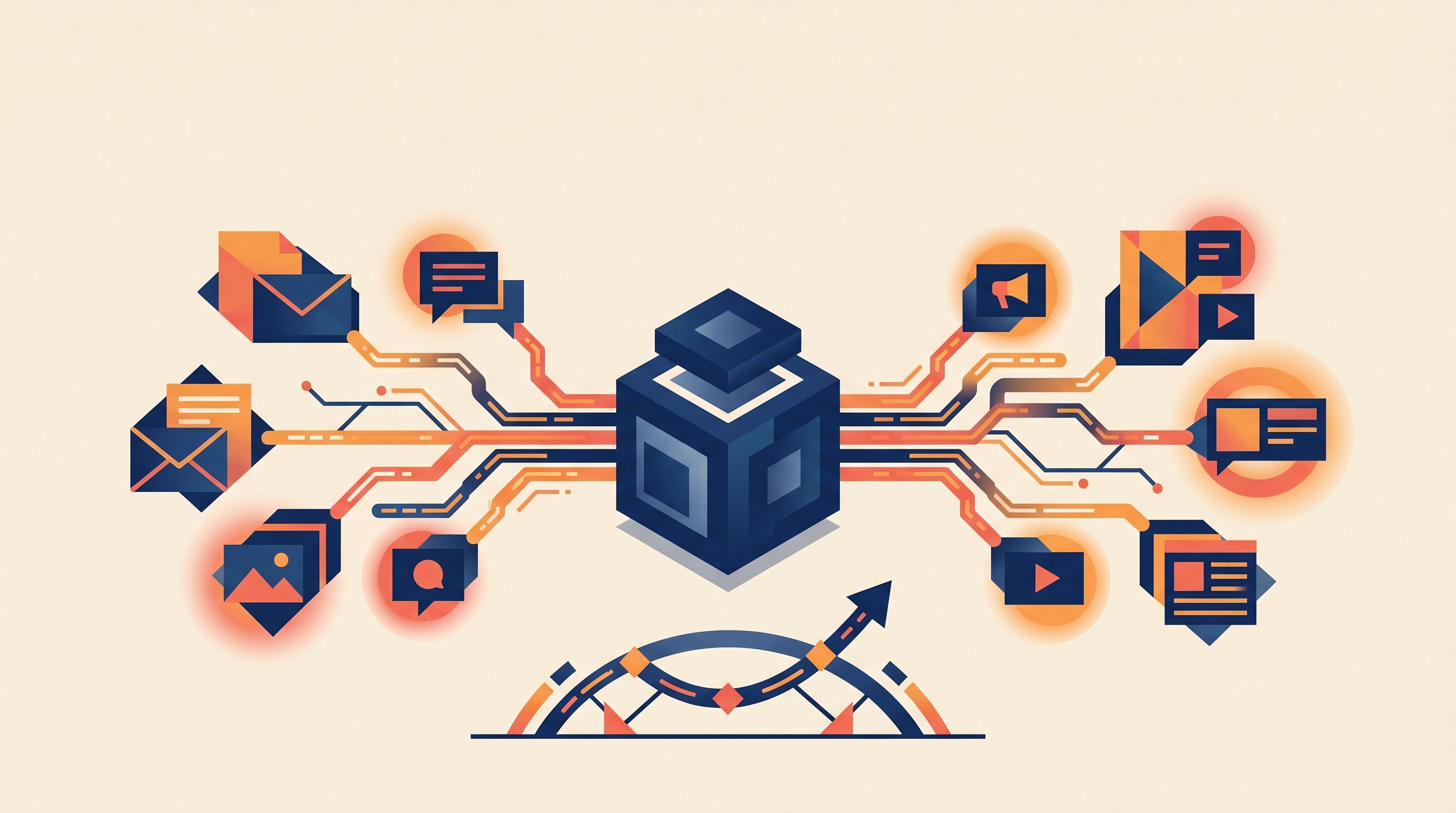
AI marketing works by analyzing massive amounts of customer data to identify patterns, predict behaviors, and automatically execute personalized campaigns at scale. Instead of guessing what customers want, AI systems process purchase history, website behavior, email engagement, and demographic data to determine the exact message, timing, and channel that will drive each individual to take action.
The core process involves three steps: data collection from multiple touchpoints, pattern recognition to segment audiences and predict outcomes, and automated execution of personalized campaigns across email, social media, advertising, and content creation. Modern AI marketing platforms can analyze thousands of customer interactions per second and adjust campaigns in real-time based on performance data.
For example, an AI system might notice that customers who view a specific product page on Tuesday evenings and have previously purchased similar items are 73% more likely to convert when they receive an email with a limited-time discount within 2 hours. The system then automatically sends that exact email to similar prospects, measures the results, and refines the approach for future campaigns.
Unlike basic automation that follows simple if-then rules, AI marketing continuously learns from every interaction to improve performance without human intervention. This creates a feedback loop where campaigns become more effective over time.
What Data Does AI Marketing Use?
AI marketing systems consume five primary types of data to build accurate customer profiles and predict behavior.
Behavioral data tracks every digital interaction: website pages visited, time spent on content, email opens and clicks, social media engagement, and purchase patterns. This creates a detailed map of how customers navigate your brand ecosystem. Demographic and firmographic data includes age, location, job title, company size, and industry. This helps AI systems understand context and tailor messaging to specific audience segments. Transactional data covers purchase history, order values, frequency, seasonal patterns, and product preferences. AI uses this to predict future buying behavior and identify upsell opportunities. Communication preferences reveal which channels customers prefer (email, SMS, social media), optimal send times, and content formats that drive engagement. Third-party enrichment data fills gaps by adding external information like company news, funding events, or industry trends that might influence buying decisions.
The key is combining all these data sources into a unified customer profile. A customer might browse your website on mobile during lunch breaks, engage with LinkedIn posts in the evening, and make purchases on desktop during business hours. AI connects these seemingly separate interactions to create one coherent customer journey.
How Does AI Predict Customer Behavior?
AI marketing prediction works by identifying statistical patterns in historical data and applying them to current prospects. The system doesn't guess—it calculates probabilities based on thousands of similar customer journeys.
Pattern recognition analyzes sequences of actions that typically lead to conversions. If customers who download three specific resources and attend a webinar convert at an 85% rate, the AI flags similar prospects for immediate follow-up. Lookalike modeling finds prospects who share characteristics with your best customers. The AI might discover that your highest-value clients all have similar job titles, company sizes, and engagement patterns, then identify new prospects matching that profile. Propensity scoring assigns numerical values to different customer actions. Opening an email might score 5 points, visiting a pricing page scores 25 points, and downloading a case study scores 15 points. When someone hits 100 points, they trigger an automated sales outreach sequence. Churn prediction identifies customers likely to cancel or stop buying. The AI notices patterns like decreased email engagement, longer periods between purchases, or reduced website activity, then triggers retention campaigns before customers actually leave. Lifetime value prediction estimates how much revenue each customer will generate over time. This helps prioritize marketing spend and customize service levels for different customer tiers.
The accuracy improves with more data. A system with six months of customer data might predict behavior with 65% accuracy, while the same system with two years of data could reach 90% accuracy.
What Marketing Tasks Can AI Automate?
AI marketing automation goes far beyond sending scheduled emails. Modern systems handle complex, multi-step campaigns that adapt based on customer responses.
Content personalization automatically adjusts website copy, email subject lines, and ad creative based on individual customer profiles. A software company might show different homepage messaging to small business owners versus enterprise executives, all happening in real-time. Campaign optimization continuously tests different elements like send times, subject lines, images, and calls-to-action. Instead of running A/B tests for weeks, AI can identify winning variations within hours and automatically shift traffic to better-performing options. Lead scoring and routing evaluates incoming leads and assigns them to appropriate sales team members. High-value prospects get routed to senior salespeople, while early-stage leads enter nurture sequences. Dynamic pricing adjusts prices based on demand, competitor analysis, and customer willingness to pay. An AI system might offer different discount levels to different customer segments simultaneously. Cross-channel orchestration coordinates messaging across email, social media, advertising, and direct mail to create consistent customer experiences. If someone clicks an email but doesn't convert, they might see retargeting ads with complementary messaging. Predictive inventory management forecasts demand and adjusts marketing campaigns accordingly. If AI predicts a product will sell out, it can automatically reduce advertising spend to avoid disappointing customers.
The key difference from basic automation is adaptability. Traditional automation follows fixed rules, while AI automation adjusts its behavior based on results.
How Do AI Marketing Platforms Learn and Improve?
AI marketing improvement happens through continuous feedback loops that analyze campaign performance and adjust strategies automatically.
Performance monitoring tracks every customer interaction and ties it back to specific marketing actions. The system knows exactly which email subject line, send time, and content combination drove each conversion. A/B testing at scale runs hundreds of simultaneous tests on different campaign elements. While humans might test two email subject lines, AI can test 50 variations across different customer segments and identify the optimal combination for each group. Attribution modeling determines which touchpoints actually influence conversions. If a customer sees three ads, opens two emails, and visits your website five times before buying, AI calculates how much credit each interaction deserves. Seasonal pattern recognition identifies recurring trends and adjusts campaigns accordingly. The system might learn that B2B customers are 40% more likely to respond to emails on Tuesday mornings in Q4, then automatically optimize send times. Competitive intelligence monitors competitor pricing, messaging, and campaign strategies to identify opportunities. If a competitor raises prices, AI might automatically increase advertising spend to capture market share. Customer feedback integration incorporates survey responses, support tickets, and sales team insights to refine customer profiles and improve targeting accuracy.
The learning process never stops. Each customer interaction provides new data points that help the AI make better predictions and decisions. This creates a compounding effect where marketing performance improves exponentially over time.
AI Marketing vs. Basic Automation: Key Differences
The difference between AI marketing and basic automation lies in adaptability and intelligence. Basic automation follows predetermined rules, while AI marketing makes decisions based on data analysis and prediction.
Basic automation works like this: "If someone downloads a whitepaper, send them Email A in 2 days, then Email B in 5 days." The sequence never changes regardless of customer behavior or campaign performance. AI marketing works like this: "If someone downloads a whitepaper and matches our high-value customer profile, send them our case study email. If they don't engage within 3 days, try a different subject line. If they click but don't convert, show them retargeting ads with social proof." Rule-based systems require manual updates when performance changes. If your automated email sequence stops working, someone needs to manually adjust the content, timing, or targeting. AI systems automatically detect performance changes and adjust strategies without human intervention. If email open rates drop, the AI might test different send times, subject lines, or sender names until performance improves. Traditional automation treats all customers the same within broad segments. Everyone in the "small business" segment gets identical messaging regardless of their specific needs or behavior patterns. AI personalization creates unique customer journeys based on individual behavior, preferences, and predicted outcomes. Two customers in the same industry might receive completely different campaigns based on their specific interaction patterns. Basic reporting shows what happened after campaigns finish. You learn that Email A had a 25% open rate three days after sending it. AI analytics provide real-time insights and predictive recommendations. You learn that Email A performs 15% better when sent on Tuesdays to customers who previously engaged with video content, and the system automatically applies this knowledge to future campaigns.
How to Measure AI Marketing Success
AI marketing success requires different metrics than traditional campaigns because the technology optimizes for long-term customer value rather than short-term engagement.
Customer lifetime value (CLV) becomes the primary success metric instead of individual campaign performance. AI might send fewer emails to high-value prospects to avoid over-communication, which could lower email open rates but increase overall revenue. Attribution accuracy improves dramatically with AI tracking. Instead of crediting the last touchpoint before conversion, AI systems map the entire customer journey and assign appropriate credit to each interaction. Predictive accuracy measures how well the AI predicts customer behavior. If the system predicts 100 customers will convert and 87 actually do, that's 87% accuracy. Higher accuracy leads to better resource allocation and campaign performance. Automation efficiency tracks how much manual work the AI eliminates. A system that automatically optimizes 500 campaign elements per day replaces weeks of human analysis and testing. Personalization effectiveness compares personalized campaigns to generic alternatives. AI-personalized emails might generate 40% higher click rates and 65% higher conversion rates than one-size-fits-all messaging. Cost per acquisition (CPA) typically decreases over time as AI systems become more efficient at targeting and conversion optimization. Initial AI implementation might increase costs, but CPA usually drops significantly after 3-6 months of learning. Revenue per customer often increases because AI identifies upsell opportunities and optimal pricing strategies that humans miss. The system might discover that customers who buy Product A are 3x more likely to purchase Product B within 30 days.
Success measurement requires patience. AI marketing systems need time to collect data and identify patterns. Expecting immediate results often leads to premature optimization changes that interfere with the learning process.
Real Limitations of AI Marketing
AI marketing has significant limitations that companies should understand before implementation. These constraints affect strategy and set realistic expectations.
Data dependency means AI systems are only as good as the data they receive. Poor data quality, incomplete customer profiles, or biased historical data will produce unreliable predictions and ineffective campaigns. Cold start problems occur when launching AI systems without sufficient historical data. New companies or those entering new markets may need 3-6 months of data collection before AI can make accurate predictions. Black box decision-making makes it difficult to understand why AI systems make specific recommendations. This can create compliance issues in regulated industries and makes troubleshooting challenging when campaigns underperform. Over-optimization can lead to campaigns that perform well on paper but feel robotic to customers. AI might identify that emails sent at exactly 2:17 PM get the highest open rates, but customers might notice the unnatural precision. Bias amplification happens when AI systems learn from biased historical data. If past marketing campaigns inadvertently excluded certain demographic groups, AI might perpetuate those biases unless specifically programmed to avoid them. Privacy regulations like GDPR and CCPA limit data collection and usage, which can reduce AI effectiveness. Systems that rely heavily on third-party data may face challenges as privacy laws become stricter. Integration complexity makes it difficult to connect AI systems with existing marketing tools and databases. Many companies struggle with data silos that prevent AI from accessing complete customer information. Cost considerations include not just software licensing but also data infrastructure, training, and ongoing optimization. Small businesses might find AI marketing platforms too expensive relative to their potential return on investment.
Understanding these limitations helps companies implement AI marketing more effectively and avoid common pitfalls that lead to disappointing results.
Frequently Asked Questions
How long does it take for AI marketing to show results? Most AI marketing systems need 30-90 days to collect sufficient data and begin showing measurable improvements. Initial setup and integration typically take 2-4 weeks, followed by a learning period where the AI analyzes customer behavior patterns. Significant performance gains usually appear after 3-6 months of continuous operation and optimization.
Can small businesses afford AI marketing tools? Small businesses can access AI marketing through platforms that offer scalable pricing based on contact volume or feature usage. Entry-level AI marketing tools start around $100-300 per month, while enterprise solutions can cost $2,000-10,000+ monthly. The key is choosing platforms that provide immediate value and can grow with your business.
What happens to marketing jobs when AI automates campaigns? AI marketing shifts human roles toward strategy, creativity, and relationship building rather than eliminating jobs entirely. Marketers spend less time on manual tasks like A/B testing and data analysis, and more time on campaign strategy, content creation, and customer experience design. New roles emerge in AI system management and marketing technology optimization.
How much data do you need for AI marketing to work effectively? Effective AI marketing typically requires at least 1,000 customer interactions across multiple touchpoints over 3-6 months. This includes email opens, website visits, purchases, and social media engagement. Companies with fewer than 500 active customers or limited digital touchpoints may see minimal benefits from AI marketing automation.
Is AI marketing better than human-managed campaigns? AI marketing excels at data analysis, pattern recognition, and campaign optimization at scale, while humans provide creativity, strategic thinking, and emotional intelligence. The most effective approach combines AI automation for tactical execution with human oversight for strategy and creative direction. Pure AI or pure human approaches typically underperform compared to hybrid models.
Free tools you can use right now: Click Here to Explore The Tools
Related reading
Want results like this?
FUEL Marketing gives you the AI-powered marketing intelligence to grow your business.
Try FUEL Marketing